Philippine Airlines Opens Its First Manila–Chicago Nonstop: An 8,000-Mile A350 Marathon Lands at O'Hare
Philippine Airlines starts something today that has never existed before: a scheduled nonstop between Manila and Chicago. The first flight, PR132, is scheduled to leave Ninoy Aquino International Airport at 4:40 p.m. local time on Monday, November 9. Thanks to the date line, it lands at Chicago O'Hare at about 4:55 p.m. Central the same day. The return, PR133, is scheduled to leave O'Hare at 10:45 p.m. and reach Manila at 5:25 a.m. two calendar days later.
The route runs three times a week in each direction, on Mondays, Wednesdays and Fridays, on the airline's Airbus A350-900. Aviation Week calls it the first nonstop scheduled passenger route between the Philippines and the U.S. Midwest. Chicago becomes Philippine Airlines' eighth U.S. destination, joining Honolulu, Los Angeles, San Francisco, Seattle, New York, Guam and Saipan.
The numbers
Simple Flying, citing Cirium schedule data, puts the eastbound leg to Chicago at 14 hours 15 minutes of block time. The westbound leg back to Manila takes 16 hours 40 minutes because it flies into the prevailing winds over the Pacific. The Contrail puts the distance at about 8,100 miles. The A350-900 on the route seats 295: 30 in business class with flat beds, 24 in premium economy and 241 in economy, nine across. Cirium data shows the flights planned year-round, peaking at 14 departures a month in March 2027.
"Chicago is considered one of the premier hubs in the United States, and our entry into this vibrant city will provide direct connectivity to the Midwest," Philippine Airlines President Richard Nuttall said, as quoted by Simple Flying.
Why it matters to travelers
Filipino American families across the Midwest have always had to connect, usually through the West Coast or an Asian hub like Tokyo or Taipei. Now they can make the trip on one long flight. The early-morning arrival in Manila is timed for connections to Philippine domestic points like Cebu, Davao, Palawan and Boracay, and to the airline's wider Asian network. Philippine Airlines has also pitched the route for cargo, with Midwest shipments connecting through Manila.
Why it matters from the cockpit
A flight this long isn't just a regular trip that happens to go farther. A block time over 16 hours means a larger crew, with relief pilots and onboard rest. The fuel plan has to account for strong headwinds, oceanic routing and alternate airports across the Pacific. And the roughly six hours between landing in Chicago and leaving again is a tight window for catering, fueling, cleaning and any maintenance issues.
Then there's the body. Crossing that many time zones scrambles your sleep no matter how many times you've done it, and managing fatigue on ultra-long-haul flying is a real discipline. The route looks great on a map, but somebody still has to be sharp for the approach into O'Hare after 14 hours in the seat.
The A350 is what makes a long route like this work. It's a twin-engine jet with the range to fly nonstop between the Midwest and Southeast Asia, and it's small enough to fill three times a week instead of daily. It's worth watching whether Chicago fills those 295 seats through the winter, and whether other Asian airlines start looking at the middle of the country instead of stopping at the coasts.
More from Mike and Tom: https://www.theblackboxaviationpodcast.com
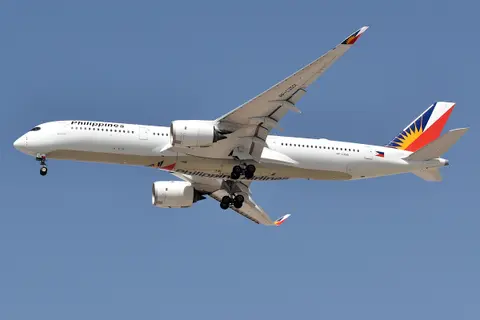
Photo: Philippine Airlines Airbus A350-941 RP-C3501 (representative aircraft, not the inaugural flight), Anna Zvereva / Wikimedia Commons, CC BY-SA 2.0, via Wikimedia Commons.

Sources
Simple Flying: https://simpleflying.com/philippine-airlines-launches-new-17-hour-us-route-1-day/
Aviation Week: https://aviationweek.com/air-transport/airports-networks/routes-networks-latest-rolling-daily-updates-wc-nov-9-2026
The Contrail: https://www.thecontrail.org/chicago-to-manila-nonstop-philippine-airlines/
Philippine Airlines press release: https://www.philippineairlines.com/us/en/newsevent-listingpage/press-releases-statements/first-non-stop-service-between-manila-chicago.html
Air France A350’s Wrong Turn After LAX Takeoff Prompts Traffic Alert