Air France A350’s Wrong Turn After LAX Takeoff Prompts Traffic Alert
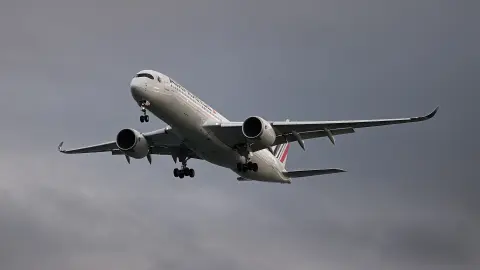
An Air France Airbus A350 and an American Airlines Airbus A321 became involved in a departure conflict at Los Angeles International Airport early Saturday, November 7, according to aviation reports published overnight Sunday. Both flights continued to their destinations.
The reports describe an unauthorized left turn by Air France Flight 28, bound for Papeete, Tahiti, after departing runway 24L. American Flight 1660, headed to Dallas/Fort Worth, had departed the airport’s southern runway complex from runway 25R.
For two airplanes climbing away from parallel runways, an unexpected turn toward the other departure stream can create a problem quickly.
What the reports describe
Simple Flying and One Mile at a Time, citing flight tracking and a published air traffic control recording, report that the Air France aircraft turned left toward the American departure instead of following its assigned departure instructions.
According to Aviation A2Z’s account of the recording, the controller instructed Air France 28 to fly heading 270 immediately. American 1660 received a traffic alert and an instruction to maintain 2,000 feet.
The reported distances deserve careful wording. Simple Flying cited approximately 400 feet of vertical separation, while One Mile at a Time described the traffic as less than a mile apart. Those figures describe different dimensions of separation; they should not be combined into a single closest-approach distance. An official reconstruction would be needed to establish the precise geometry and whether applicable separation standards were breached.
The question is why the turn happened
One Mile at a Time reports that the Air France crew correctly read back an initial instruction involving the DLREY navigation fix. After the conflict, the controller questioned the crew about the turn and their assigned departure. The pilots reportedly responded “standby” before later receiving a telephone number concerning a possible pilot deviation.
That exchange does not establish what caused the turn. A correct readback tells us what was said on the radio—not necessarily what was entered into the flight management system, understood during the briefing, or followed after takeoff.
At the time of the cited reporting, there was no published FAA or NTSB finding explaining the event. Simple Flying said it had contacted Air France for comment. Until more information is available, assigning a cockpit mistake or a procedural cause would be speculation.
Why this matters
LAX’s northern and southern runway complexes handle separate streams of departing traffic. Published procedures and controller instructions help keep those streams apart while crews are climbing, configuring the airplane, and communicating with departure control.
In this reported encounter, the controller issued corrective instructions and both flights continued safely. That is the reassuring outcome. The developing conflict still deserves scrutiny—not a declaration that everything worked perfectly, and not an assumption that a collision was inevitable.
The useful questions are specific: What clearance was issued? What path did each airplane actually fly? What alerts occurred? And what can prevent the same conflict from developing again?
For more on the work behind the frequency, listen to Mike and Tom’s conversation with FAA controller Ian in An Air Traffic Controller Tells All.
Sources: Simple Flying, One Mile at a Time, and Aviation A2Z.
Photo caption: Representative photo of Air France Airbus A350-900, registration F-HUVK, photographed at Boston in November 2024—not the aircraft involved in the reported LAX event. Photo: 4300streetcar / Wikimedia Commons, CC BY 4.0.

NTSB: Storm-Damaged Southwest 737 MAX Flew 44 Times Before Its Dutch Roll Event