JSX Just Bought a Dead Airline. What It Really Wants Is the Part 121 Certificate
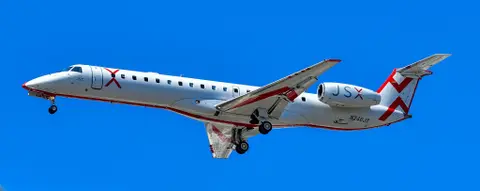
JSX, the semi-private jet operator that flies 30-seat Embraers out of private terminals, has bought New Pacific Airlines. That's the carrier that started life as Northern Pacific, the Boeing 757 startup that wanted to link the U.S. mainland and Asia through Anchorage.
Photo: JSX Embraer ERJ-145LR N246JX at Las Vegas Harry Reid International Airport, May 2025. Tomás Del Coro, CC BY-SA 4.0, via Wikimedia Commons.
A filing posted Nov. 20 on the Department of Transportation's docket (DOT-OST-2026-4654) says New Pacific intends to resume flying. Not with 757s, but with Embraer ERJ145-LR regional jets leased from JSX, configured with 42 seats. That's 12 more than JSX sells on its own airplanes today.
According to the operating projection reported by View from the Wing, the plan is:
- Two aircraft at the start, growing to six by the fifth month
- 10,106 flights and about 309,000 passenger boardings in the first year
- Flights averaging about 1.2 hours gate to gate
- Staffing growing to 104 employees
New Pacific also asked DOT to waive the usual 45-day advance filing requirement. The filing doesn't name routes or a start date, and JSX isn't saying much. Its statement to View from the Wing: "JSX is continually evaluating opportunities to support its long-term growth and bring its distinctive flying experience to more Customers and more communities. As part of that work, we are pursuing additional pathways that could provide even more ways to deliver our award-winning service in the future."
Why buy an airline with no airplanes?
New Pacific never got its Anchorage plan off the ground. The closure of Russian airspace to U.S. carriers undercut it, the airline pivoted to short domestic flying, including Ontario, California to Nashville, then to sports and corporate charters, and it shut down. Its 757s went away in the bankruptcy process.
What survived is the thing JSX doesn't have: a Part 121 certificate.
JSX flies its nearly 60 airplanes, mostly ERJ-135s and ERJ-145s, under Part 135 as a public charter. That structure caps each flight at 30 seats, and it's why JSX passengers skip the standard TSA checkpoint. Part 121 is the rulebook the scheduled airlines live under. Building a 121 certificate from scratch takes a long time. Buying one that already exists is a shortcut.
There's also a regulatory angle. American, Southwest and the Air Line Pilots Association have pushed regulators to rein in public charter operations that look a lot like scheduled airline service. View from the Wing notes the FAA's public charter rulemaking is still listed as a long-term action with no next step set. One Mile at a Time called the deal an insurance policy: if the rules ever tighten, JSX already has a 121 operation in the family.
The pilot side of this
This is the part we keep coming back to. Moving flying from 135 to 121 isn't just a paperwork change. It changes who can sit up front.
Under Part 121, both pilots need an Airline Transport Pilot certificate, or a restricted ATP, the requirement that came out of the Colgan 3407 accident. Part 135 is more flexible, and One Mile at a Time notes that's part of how JSX can hire pilots with fewer than 1,500 hours. Part 121 also brings the mandatory age 65 retirement rule. As View from the Wing points out, that matters for an operator that has hired senior captains retired from the majors.
For passengers, 42 seats in an ERJ-145 is still roomier than a traditional 50-seat regional jet, but it's not the same cabin as JSX's current 30-seat setup. View from the Wing also notes that federal security rules allow scheduled and public charter flights with 31 to 60 seats to operate outside the usual secure terminal area, so a private-terminal experience isn't necessarily off the table, though airport certification rules would limit where that works.
Anyone who's been around regional flying knows the ERJ-145 as the workhorse 50-seater. It's funny to watch that airframe end up at the center of one of the more creative regulatory moves we've seen in a while.
What happens next is up to DOT, which has to act on New Pacific's filing and waiver request. We'll be watching for routes, and for how JSX staffs the cockpit.
We talked about how the Colgan accident reshaped airline pilot qualifications, including the 1,500-hour rule, in our episode The Crash That Changed the Airline Industry Forever: Colgan Air 3407.
Sources
- Ishrion Aviation (@IshrionA) on X, "JSX acquires New Pacific Airlines," https://x.com/IshrionA/status/2123894054207558027 (Nov. 20, 2026, 4:39 PM ET)
- U.S. Department of Transportation docket DOT-OST-2026-4654, "Application and Notice of New Pacific Airlines, Inc. and Motion for Confidential Treatment," https://www.regulations.gov/document/DOT-OST-2026-4654-0001 (posted Nov. 20, 2026)
- One Mile at a Time, Ben Schlappig, "Why JSX Just Bought New Pacific Airlines, The Strange, Failed 757 Startup," https://onemileatatime.com/news/jsx-buys-new-pacific-airlines/ (Nov. 20, 2026, 7:26 PM ET)
- View from the Wing, Gary Leff, "JSX Buys New Pacific Airlines—42 Seat Jets Could Bring Its Private Terminal Flights To More Travelers," https://viewfromthewing.com/jsx-buys-new-pacific-airlines-42-seat-jets-could-bring-its-private-terminal-flights-to-more-travelers/ (Nov. 20, 2026, 9:44 PM ET)
NTSB: A Misrigged Flap, Not the Pilots, Brought Down Kamaka Air's Caravan in Honolulu