NTSB: A Misrigged Flap, Not the Pilots, Brought Down Kamaka Air's Caravan in Honolulu
The National Transportation Safety Board has published its final report on the Kamaka Air crash in Honolulu on December 17, 2024. Its finding is one that every pilot dreads: the airplane was set up to fail before it ever left the ground, and the two pilots on board had almost no way to see it coming.
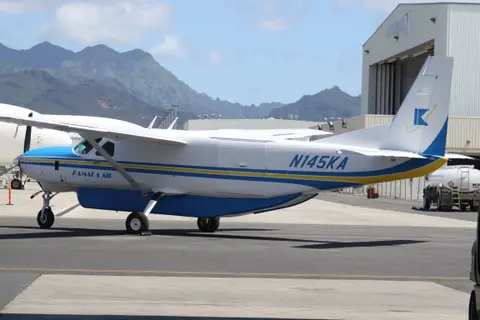
Featured photo: A Kamaka Air Cessna 208B Grand Caravan (N145KA) at Honolulu, June 2012. Not the accident aircraft. Photo: Aeroprints.com, CC BY-SA 3.0, via Wikimedia Commons.

Flight instructor Preston Kaluhiwa, 26, and Hiram deFries-Saronitman, 24, were killed when their Cessna 208B Grand Caravan, N689KA, rolled left just after takeoff from runway 4L at Daniel K. Inouye International Airport and hit an abandoned building north of the field. It was a Part 91 training flight in Kamaka Air's second-in-command program, headed to Lanai.
What the NTSB found
The probable cause, in the board's words: "the in-flight failure of the flap system's left interconnect rod due to preload from improper maintenance, which resulted in an asymmetrical flap condition and an uncommanded left roll at an insufficient altitude for recovery."
Contributing: Kamaka Air's "failure to follow its FAA-approved maintenance program and inadequate training and supervision of its mechanics."
Here's how it played out. The crew took off with 20 degrees of flaps, which matched the company's training manual. Before the end of the runway the airplane started a shallow left turn when the tower had told them to fly runway heading and then turn right. When the controller asked about it, the instructor answered, "We are out of control here." The Caravan got to about 350 feet above the ground before the bank steepened and it went down. The engine was making power.
The NTSB looked at about two seconds of camera video and found the right flap at about 20 degrees and the left at about 5. On the Caravan, one actuator drives both flaps through a chain of bellcranks, pushrods, interconnect rods, and cables. The left interconnect rod had been bent under compression and then broke. Once it let go, the left flap came up and the right one stayed down.
The maintenance trail
About 10 weeks before the crash, after the flaps wouldn't retract following a landing on Molokai, a mechanic swapped the primary flap motor. The job took about an hour, at night, away from the maintenance base. The NTSB noted that Cessna's maintenance manual has no procedure for replacing just that motor. The only motor replacement it describes covers the whole actuator assembly, and the flaps have to be re-rigged afterward. The paperwork showed a functional check, but investigators said it was unlikely every required step got done. They couldn't say exactly when the system was misrigged. They did say the checks, done as written, would likely have caught it.
The problems weren't limited to one airplane. Mechanics told investigators there was no formal training; they learned by shadowing each other. One of the company's two cable tensiometers had been out of calibration for about a month that fall. After the crash, Kamaka Air checked its six other Caravans and found flap cable tension out of tolerance on four of them, according to AeroCorner's reading of the report. The FAA had flagged recordkeeping problems two to three months before the accident, and that work was still going on when it happened.
Why it matters
As pilots, this is the one that keeps you up at night. You walk around the airplane, you check what you can see, and you trust the logbook for everything else. The NTSB said the bent rod and the worn cables wouldn't have been visible on a preflight. The Caravan's handbook does have a split-flap procedure: stop the roll with aileron and rudder, flaps up, and slow down. But at a few hundred feet, at takeoff power, with no idea the flaps were split, there's very little time to figure it out. The board said the crew likely never realized what was happening.
It's not a one-off for the type, either. Textron Aviation told investigators it had 16 reports of misrigged Caravan flap systems between June 2015 and September 2025.
The family's attorney told Hawaii News Now the crash "was not the result of pilot error." Kamaka Air said it cooperated with the investigation and will review the report. CEO Peter Banfield called Preston and Hiram the company's "'ohana."
We talked about maintenance shortcuts, safety culture, and why people need to feel safe speaking up in our episode 21 Air Whistleblower: Safety Complaints & Retaliation. This report is another reminder that safety doesn't start in the cockpit. It starts in the hangar.
Our thoughts are with the Kaluhiwa and deFries-Saronitman families.
Sources
- Honolulu Star-Advertiser: "Fatal 2024 plane crash in Honolulu due to maintenance failures, NTSB report says", Nov 20, 2026
- Hawaii News Now: "NTSB: Improper maintenance led to deadly 2024 Kamaka Air crash", Nov 20, 2026
- AeroCorner: "Kamaka Air Crash: NTSB Blames Flap Maintenance", Nov 21, 2026
- Aviation Today: "NTSB Links Improper Flap Maintenance To Fatal 2024 Kamaka Air Crash In Honolulu", Nov 21, 2026
JSX Just Bought a Dead Airline. What It Really Wants Is the Part 121 Certificate