Whose Fault Was the FAA Ground Stop? The Contractor, the Router Maker, and the Techs Who Say They Were Left Out
Three days after Friday's nationwide ground stop, flights are mostly back to normal. The argument over who's to blame is just getting started.
On Monday, Transportation Secretary Sean Duffy said on CNBC that it's still unclear why a router installed by FAA contractor L3Harris Technologies at a remote FAA radio communications site in El Dorado, Arkansas, set off the nearly five-hour ground stop, Reuters reported at 1:28 p.m. ET. The shutdown led to more than 18,000 canceled flights.
What's new Monday
- The hardware. According to the FAA, L3Harris had been installing Juniper Networks routers to replace Cisco routers built in 2001. The FAA said those old routers were supposed to have been replaced in 2006.
- How big it got. Duffy said the El Dorado installation overloaded a key government communications system at a rate of 1,000 connection attempts every four to five seconds. That destabilized aircraft communications and radar feeds at 17 of the FAA's 22 en route centers.
- A second site. The FAA said Sunday that the data overload may have come from two places: El Dorado and a radar site in Amarillo, Texas. Duffy said L3Harris had replaced the router in Amarillo three weeks earlier.
- The fix, for now. The FAA said that when the data "inconsistencies" showed up, L3Harris blocked both locations, which stabilized the network. As a precaution, the broadcasting function has been turned off on all of the new routers.
- The router maker pushes back. Hewlett Packard Enterprise, which owns Juniper Networks, said that based on what it knew Sunday, the Juniper device was "functioning exactly as intended."
- Wall Street noticed. L3Harris shares fell 3.3% Monday and HPE shares fell 4.5%, according to Reuters.
So right now the contractor is cooperating with the investigation, the router's maker says its box did what it was supposed to do, and the government still hasn't said publicly whether this was bad equipment or a bad installation.
The FAA techs say they weren't in the room
Then there's the union for the FAA's own technicians. The Professional Aviation Safety Specialists (PASS) says its people weren't part of the work.
"The issue was isolated to two contractor owned and maintained routers that were being updated mid-day," PASS said in a statement posted Saturday. "Historically contractors have followed a protocol where FAA employees conduct a risk assessment and coordinate the maintenance of the system or equipment. PASS-represented technicians were not involved in the upgrades that led to the ground stop."
PASS says it supports modernization. It also points out that the FAA's own May 2026 workforce plan calls for at least 750 more certified professional technicians by 2030, and says "little progress has been made on hiring those new technicians." We haven't seen the FAA publicly answer the union's claim that the usual FAA risk assessment didn't happen. That's one of the questions investigators will need to answer.
The money fight
Duffy wants to get out from under the current setup. L3Harris owns the FAA's telecom network, and he wants Congress to pay for a new one built and operated by AT&T, Verizon and Lumen. "I want to get away from L3Harris and get to a new one. But they own the network. So I can't cancel the network that they own and I operate on," he said on NBC Sunday, according to Reuters. On Friday night he raised his funding ask from $30 billion to $50 billion, AirlineGeeks reported.
House Democrats aren't sold yet. Reps. Rick Larsen and André Carson, the top Democrats on the House Transportation Committee and its aviation subcommittee, said Congress already approved $12.5 billion for air traffic control upgrades, and that 15 months later the administration has obligated $4.3 billion and spent $1 billion, AIN reported. "Explain to Congress, again, why they need more money?" they said.
Why it matters to pilots and passengers
From the flight deck, the scary part of Friday wasn't the delay. It was a failure in something most of us never think about: the phone lines and network gear that carry our radio calls and radar data between the airplane and the controller. When that plumbing hiccups, controllers lose confidence in what they're seeing and hearing, and the safe answer is to stop launching airplanes. That's exactly what they did.
The lesson so far is less about one bad router and more about process. In airline flying, almost nothing touches a live system without a checklist, a second set of eyes, and somebody asking "what happens if this goes wrong?" Swapping out 20-year-old network gear in the middle of a weekday, on a network the whole National Airspace System depends on, is the kind of job that deserves the same discipline. Whether the risk assessment PASS describes happened, and if not, why not, will tell us a lot about whether this can happen again in the middle of Thanksgiving week.
For travelers, the near-term news is good. The FAA says it isolated the problem, and the new routers' broadcast function is off. The bigger fix, a new telecom network, depends on Congress and is years away even if it gets funded.
We've covered this story since Friday: the ground stop itself, what caused it, and how the airlines recovered. For what the job looks like from the other side of the radio, listen to our episode An Air Traffic Controller Tells All: Overtime Rules, Flight Delays & the Beijing Skyscraper Crash.
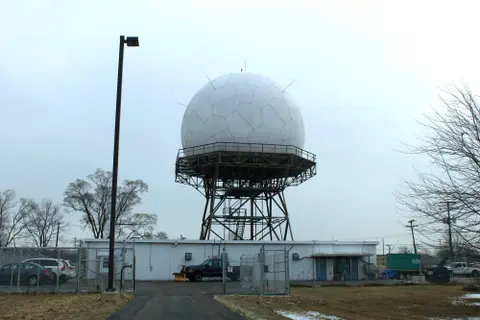
Featured photo: FAA Joint Surveillance Site radar near Canton, Michigan (file photo, not one of the sites involved). Photo: Dwight Burdette, CC BY 3.0, via Wikimedia Commons.
Sources
- Reuters (David Shepardson), "US probes why a router installation sparked mass flight grounding," Nov. 16, 2026, 1:28 p.m. ET. https://www.streetinsider.com/Reuters/US+probes+why+a+router+installation+sparked+mass+flight+grounding/27352792.html
- Aviation International News (Curt Epstein), "Questions Remain Regarding FAA Groundstop on Friday," Nov. 16, 2026, 12:36 p.m. ET. https://www.ainonline.com/aviation-news/air-transport/2026-11-16/questions-remain-regarding-faa-groundstop
- Professional Aviation Safety Specialists (PASS), "PASS On the Nationwide Ground Stop," posted Nov. 14, 2026, 8:26 p.m. ET. https://passnational.org/news/pass-on-the-nationwide-ground-stop/
- AirlineGeeks (Zach Vasile), "Flight Disruptions Ease; DOT Lays Blame for ATC Outage," Nov. 16, 2026, 9:31 a.m. ET. https://airlinegeeks.com/2026/11/16/flight-disruptions-ease-dot-lays-blame-for-atc-outage/
Korean Air Pilots Reach a Tentative Deal Ahead of the Asiana Merger, but the Seniority Fight Isn't Over