The FAA Ground-Stopped Every U.S. Airport This Afternoon. It's the First Nationwide Stop Since January 2023.
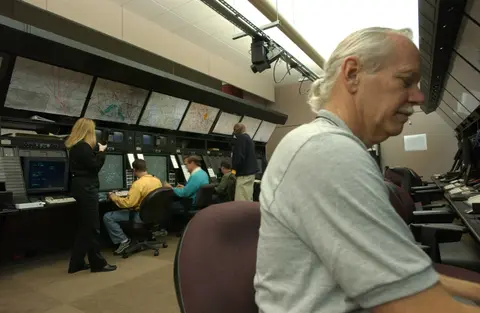
Photo: Federal Aviation Administration, public domain. File photo of Washington Air Route Traffic Control Center.
It was Friday the 13th.
At 3:54 p.m. Eastern on November 13, 2026, the FAA's Air Traffic Control System Command Center issued a nationwide ground stop for all U.S. airports. The advisory, posted in Flightradar24's live coverage, said it was "due to extraordinary circumstances and for reasons of safety," that "all departing traffic should remain ground stopped until further notice," and that inbound international flights would be "managed on a case by case basis." Aircraft already in the air were allowed to continue and land.
This is the first time the FAA has ground-stopped departures at all U.S. airports since January 11, 2023.
What the FAA has said
Transportation Secretary Sean Duffy posted at 4:16 p.m. Eastern that the stop followed "a communication issue impacting all Air Route Traffic Control Centers," and that "FAA technicians are investigating the issue." The FAA's own statement, quoted by Axios and CNBC, used slightly narrower language: "communication issues impacting multiple Air Route Traffic Control Centers." Flightradar24 said the FAA cited an equipment outage affecting air traffic control frequencies. The Washington Examiner, citing two FAA employees, described a "rolling frequency outage." The FAA has not named a specific system or said what broke.
There are 22 Air Route Traffic Control Centers in the United States. They work the high-altitude, en route airspace. When those frequencies go quiet, you cannot keep launching airplanes into a system you may not be able to talk to. Earlier in the afternoon, CBS Chicago reported, the FAA had already ground-stopped O'Hare and Midway for an equipment outage and "comms issues" before the stop went nationwide.
What a ground stop looks like from the cockpit
A ground stop is not a shutdown of U.S. airspace, and it is not automatically a cancellation. If you are already airborne, you keep flying and land. If you are at the gate, or you have pushed and you have not taken off, you stay put. Inbound airplanes are still arriving, so gates get tight, and the recovery is often the hard part: crews time out, airplanes end up in the wrong places, and the first hour after the stop lifts can look worse than the stop itself. If you were flying Friday afternoon, check the airline app before you leave for the airport.
Flightradar24 said 4,042 flights were already airborne and bound for U.S. airports when the stop began. By 4:20 p.m. Eastern, that number was down to 3,100, with no additional airplanes taking off. News 9 reported that as of about 4:45 p.m. Eastern, FlightAware was showing 7,884 delays and 340 cancellations for flights within, into, or out of the United States. Some of those delays predated the stop because of weather, so that total is not a clean count of flights the outage stopped.
The advisory listed an estimated end around 11:00 p.m. Eastern, with an effective window running to 11:30 p.m., but the order itself was "until further notice." As of about 4:50 p.m. Eastern, neither Duffy nor the FAA had announced that the nationwide stop had been lifted. The FAA's public National Airspace System Status page no longer listed a nationwide ground stop, but departure delays were still showing at multiple airports with reasons coded to a national stop or FAA equipment.
The last time this happened
Nationwide ground stops of all departures are extremely rare. Airline-specific holds have happened since 2023, when a single carrier asked the FAA to hold its own airplanes. That is not the same thing as stopping every airport in the country.
The last all-airport stop was January 11, 2023, when the FAA's Notice to Air Missions, or NOTAM, system went down. Then-Acting Administrator Billy Nolen told Congress he ordered a nationwide ground stop at about 7:15 a.m. Eastern and lifted it at 9:07 a.m. The FAA later said contract personnel had unintentionally deleted files while trying to fix a database, and that it found no evidence of a cyberattack. CNN, citing FlightAware as of 6 p.m. Eastern that evening, reported more than 9,500 delays and more than 1,300 cancellations.
Before that, the last time the FAA stopped civilian departures nationwide was September 11, 2001. That day went much further: a national ground stop of all civilian takeoffs at 9:25 a.m., then an order at 9:45 a.m. for every airborne civil aircraft to land. More than 4,500 flights were in the air. Today's order is in that rare category of a nationwide departure stop. It is not a repeat of the 2001 airspace shutdown.
We still do not know what equipment failed, how long the stop will last, or how ugly the recovery will be. Listen to An Air Traffic Controller Tells All for more on how this system really runs. If you are traveling tonight, keep checking with your airline.
Sources
- Flightradar24, "Nationwide ground stop issued for United States," Ian Petchenik, live blog updated Nov 13, 2026 (stop issued 20:54 UTC / 3:54 p.m. ET; 4,042 airborne U.S.-bound flights at issuance; advisory text; frequency outage; Duffy update at 21:16 UTC): https://www.flightradar24.com/blog/live/nationwide-ground-stop-issued-for-united-states/
- Flightradar24 (@flightradar24), "Issued by the FAA just moments ago, ALL US airports are currently ground stopped...," Nov 13, 2026, 4:01 p.m. ET (21:01:08 UTC): https://x.com/flightradar24/status/2121347654714077605
- Flightradar24 (@flightradar24), "There are currently 3,100 airborne aircraft bound for US airports...," Nov 13, 2026, 4:19 p.m. ET (21:19:59 UTC): https://x.com/flightradar24/status/2121352399704989835
- Secretary Sean Duffy (@SecDuffy), "The @FAAnews issued a nationwide ground stop... communication issue impacting all Air Route Traffic Control Centers...," Nov 13, 2026, 4:16 p.m. ET (21:16:46 UTC): https://x.com/SecDuffy/status/2121351591106072679
- Axios, "FAA issues nationwide ground stop due to 'extraordinary circumstances,'" Alex Fitzpatrick, Nov 13, 2026 (FAA statement: communication issues impacting "multiple" ARTCCs): https://www.axios.com/2026/11/13/faa-nationwide-ground-stop
- CNBC, "FAA issues nationwide ground stop citing ATC communication issues," Leslie Josephs, published Nov 13, 2026, 4:01 p.m. ET (FAA statement; Alaska Airlines internal message on communications and radar issues): https://www.cnbc.com/2026/11/13/faa-ground-stop.html
- CBS Chicago, "FAA issues ground stops at Chicago O'Hare and Midway airports due to 'equipment outage,'" Sara Tenenbaum, updated Nov 13, 2026, 3:43 p.m. CST: https://www.cbsnews.com/chicago/news/ground-stop-chicago-ohare-midway-airports-equipment-outage/
- Washington Examiner, "FAA imposes nationwide ground stop on all flights," Anna Giaritelli, published Nov 13, 2026, 4:06 p.m. ET, updated 4:10 p.m. ET ("rolling frequency outage," citing two FAA employees): https://www.washingtonexaminer.com/policy/infrastructure/4802941/faa-imposes-nationwide-ground-stop-on-all-flights/
- ABC News, "Rare nationwide ground stop ordered at airports over communication issues: FAA," Ayesha Ali and Ivan Pereira, Nov 13, 2026, 4:35 p.m. ET (22 ARTCCs; last nationwide stop in 2023): https://abcnews.com/US/nationwide-ground-stop-ordered-airports-faa/story?id=138121848
- News 9 (Oklahoma City), "FAA orders nationwide ground stop until 10 p.m. following communication issue," Cassidy Mudd, Nov 13, 2026, 3:46 p.m. CT (advisory timing; estimated end 10 p.m. CT / effective period to 10:30 p.m. CT; FlightAware 7,884 U.S. delays and 340 U.S. cancellations as of about 3:45 p.m. CT / 4:45 p.m. ET): https://www.news9.com/oklahoma-city-news/faa-reportedly-issues-nationwide-ground-stop
- USA Today, "Ground stop live updates: FAA orders flights to remain grounded nationwide," Anthony Thompson, updated Nov 13, 2026, 4:46 p.m. ET (still describing the stop as in effect; advisory window): https://www.usatoday.com/story/news/nation/2026/11/13/faa-orders-nationwide-groundstop-at-us-airports-citing-safety/92765499007/
- FAA National Airspace System Status, checked Nov 13, 2026, 4:49 p.m. ET: https://nasstatus.faa.gov/
- FAA, Statement of Billy Nolen, Acting Administrator, Senate Commerce Committee testimony on the Jan 11, 2023, NOTAM outage (ground stop about 7:15 a.m. EST, lifted 9:07 a.m. EST; no evidence of a cyberattack): https://www.faa.gov/testimony/statement-billy-nolen-acting-administrator-federal-aviation-administration-hearing-united
- CNN, "FAA system outage causes thousands of flight delays and cancellations across the US," Pete Muntean and Gregory Wallace, published Jan 11, 2023, 6:37 a.m. ET, updated 9:27 p.m. ET (FlightAware: more than 9,500 delayed and more than 1,300 canceled as of 6 p.m. ET): https://www.cnn.com/travel/article/faa-computer-outage-flights-grounded
- FAA, A Historical Perspective, 1903-2008, Chapter 9 (Sept 11, 2001: national ground stop at 9:25 a.m.; all airborne civil aircraft ordered to land at 9:45 a.m.; more than 4,500 IFR aircraft in the air): https://www.faa.gov/sites/faa.gov/files/about/history/historical_perspective/historical_perspective_ch9.pdf
The White House Asks Congress for $30.1 Billion More to Fix Air Traffic Control and Airports