Mayday Out of Tampa: American 737 Shuts Down an Engine and Diverts to Orlando With Sen. Ashley Moody Aboard
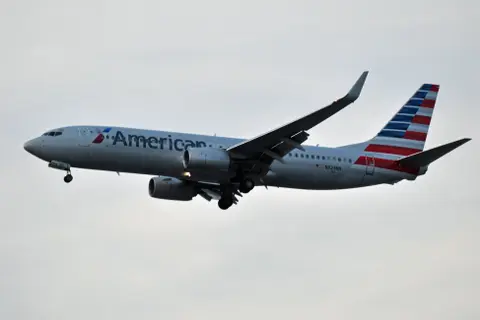
An American Airlines Boeing 737-800 headed from Tampa to Washington Reagan National shut down its left engine shortly after takeoff Monday afternoon and diverted to Orlando, where it landed safely. U.S. Sen. Ashley Moody, R-Fla., was on board and missed Monday night's Senate votes.
The FAA said the jet landed at Orlando International Airport around 3 p.m. after the crew reported an engine issue, and that it will investigate. No injuries have been reported. The cause of the engine problem hasn't been made public, and as of early Tuesday morning we hadn't seen a statement from American Airlines.
What we know
- The flight. American Airlines Flight 496, Tampa (TPA) to Washington Reagan National (DCA), Monday, Nov. 16.
- The airplane. Flight-tracking data cited by AeroCorner identify the jet as N924NN, a 2013-built 737-800 with two CFM56-7B engines.
- The timeline. FlightAware logged the departure from Tampa at 1:57 p.m. ET and the arrival in Orlando at 2:44 p.m. ET, a 46-minute trip that was supposed to end in Washington.
- On the radio. According to AeroCorner's review of a time-stamped transcript of the ATC audio, the crew asked Tampa Departure to level off at 10,000 feet for “left engine indications” while climbing through about 9,300 feet. About three minutes later they declared a mayday, said they were shutting down the left engine, and asked for vectors to one of Orlando's long runways. Offered Tampa instead, the crew stuck with Orlando, citing its runways and American's maintenance there. They reported 178 people on board and 180 minutes of fuel.
- The landing. The 737 held 10,000 feet on one engine for roughly 17 minutes while the crew ran the checklists, then landed on Orlando's Runway 36L, per the same transcript and tracking data.
- The senator. “Earlier today the American Airlines flight she was on had engine failure and had to make an emergency landing in Orlando,” Moody's office said in a statement to Punchbowl News, as reported by Fox News and WESH. “She got on the next available flight to DC but unfortunately landed just after votes closed. She is grateful to the pilots and crew for getting everyone on board on the ground safely.”
Why Orlando and not Washington, or right back to Tampa?
People always ask why a jet with a perfectly good second engine doesn't just keep going. On a two-engine airliner the answer is written into the regulations. Under 14 CFR 121.565, when an engine fails or is shut down, the captain has to land at the nearest suitable airport, in point of time, where a safe landing can be made. Only airplanes with three or more engines get leeway to press on somewhere else. Washington was more than 800 miles away. That was never an option.
“Nearest suitable” is where airmanship comes in. Tampa was right behind them, but “suitable” isn't just distance. It's runway length, weather, emergency equipment and, very often, where your airline can actually fix the airplane and take care of 178 people. Orlando is a short hop east, has long runways, and has American maintenance on the field. That's a call any of us would recognize.
What the crew did right
From the flight deck, the part of this story that stands out is how un-dramatic it sounds. The crew didn't rush. They leveled off, told ATC what they had, declared the emergency once it was clear, and then took their time at 10,000 feet with three hours of gas to work the checklists before they came down. That's exactly how we're trained in the sim: aviate, navigate, communicate, and don't let the clock make your decisions for you.
The “mayday” isn't overkill either. Declaring an emergency gets you priority, a clear frequency and the fire trucks waiting, and nobody in the cockpit is grading you on whether it was “bad enough.” The 737 flies just fine on one engine, but you still want every resource on your side.
For passengers, a single-engine diversion is scary and it ruins your day. But it's also the system working the way it's supposed to. The airplane is built to fly on one engine, the crew trains for it every recurrent cycle, and the rules force a quick, conservative landing.
What we don't know yet is why the left engine had to be shut down. That's for American's maintenance team and the FAA. We'll update this post if the airline or the FAA says more.
We covered a similar shutdown just a couple of days ago, when a British Airways 787 shut down an engine over the Mediterranean and diverted to Athens. For how airline crews work through a problem when the airplane doesn't cooperate, listen to our episode APU Failure, Flight Delays & Pilot Decision-Making | Real Airline Pilot Stories.
Featured photo: American Airlines Boeing 737-800 N924NN, the aircraft involved, on approach to Vancouver (YVR) in April 2015. Photo: Eric Salard, CC BY-SA 2.0, via Wikimedia Commons.
Sources
- AeroCorner News, “American Airlines AA496 Diverts to Orlando After an Engine Failure With Sen. Ashley Moody Aboard,” Nov. 17, 2026, 12:16 a.m. ET. https://aerocorner.com/news/american-airlines-aa496-tampa-washington-engine-failure-orlando/
- Fox News (Landon Mion), “Engine failure forces Sen. Ashley Moody's flight to divert for emergency landing,” Nov. 16, 2026, 11:08 p.m. ET. https://www.foxnews.com/politics/engine-failure-forces-sen-ashley-moodys-american-airlines-flight-divert-emergency-landing
- WESH 2 News, “American Airlines flight carrying senator makes emergency landing,” Nov. 17, 2026, 1:26 a.m. ET. https://www.wesh.com/article/american-airlines-flight-senator-emergency-landing/74448803
- 14 CFR 121.565, “Engine inoperative: Landing; reporting,” Electronic Code of Federal Regulations. https://www.ecfr.gov/current/title-14/chapter-I/subchapter-G/part-121/subpart-T/section-121.565
Flight Deck Distractions: Why Airline Pilots Get Fired for Using Cell Phones