United Flight 726 Declared an Emergency Over Puget Sound for an APU Fire Warning. Here's What We Know.
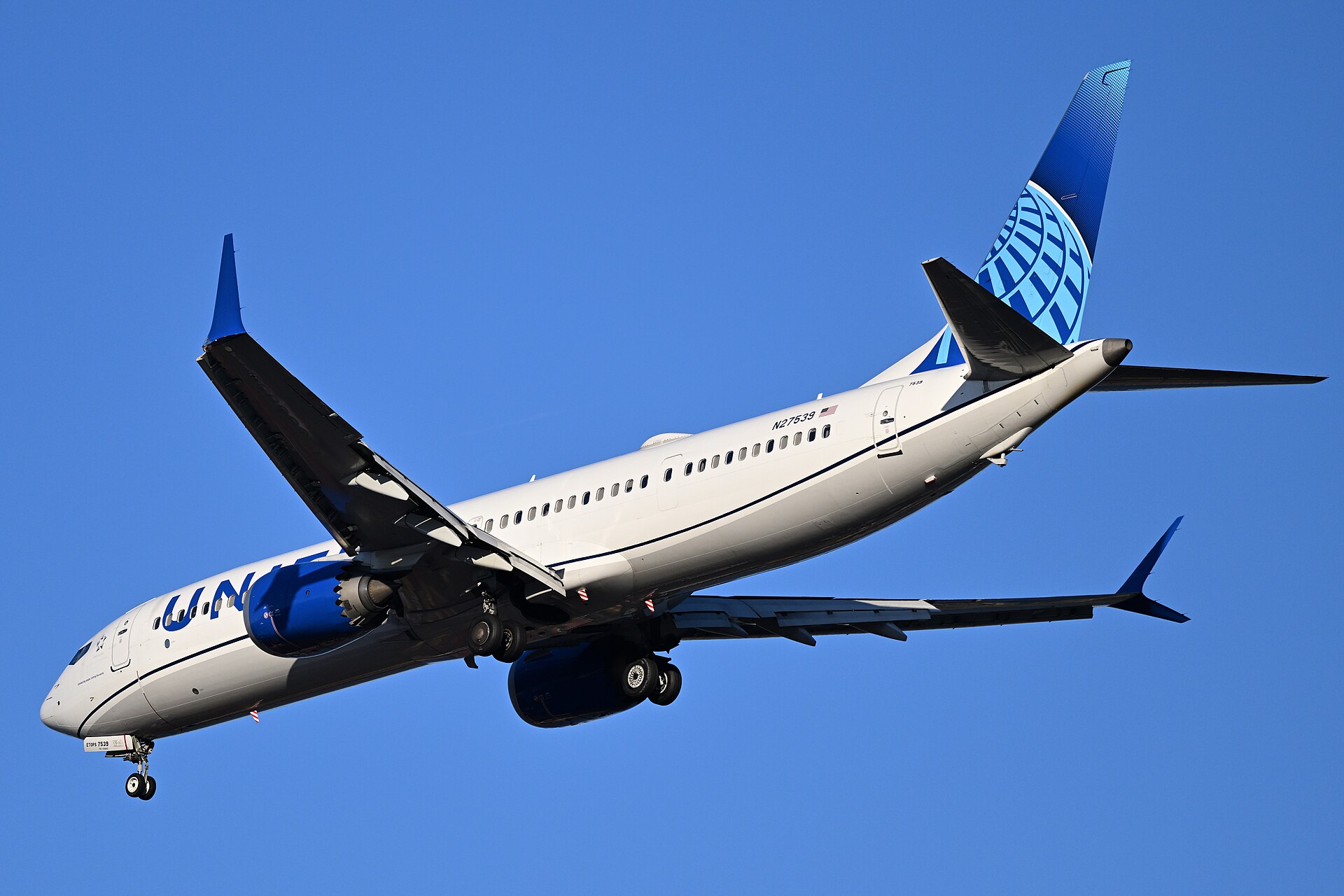
Featured photo: A United Airlines Boeing 737-9 MAX (N27539, not the aircraft involved) on final approach to Boston Logan in October 2024. The APU exhaust is the small opening at the very tip of the tail. Photo: 4300streetcar, CC BY 4.0, via Wikimedia Commons.
A United Airlines Boeing 737 MAX 9 from Los Angeles declared an emergency on its way into Seattle-Tacoma International Airport on Saturday after the crew got an APU fire indication. The airplane landed safely just before 11:30 a.m. Pacific, and everyone walked off normally at the gate.
What happened
- The flight: United Airlines Flight 726, Los Angeles to Seattle-Tacoma, operated by a Boeing 737 MAX 9.
- When: Saturday, Nov. 28, the Saturday after Thanksgiving. It landed just before 11:30 a.m. Pacific (about 2:30 p.m. ET).
- The call: On in-flight audio recordings cited by The Seattle Times, a pilot can be heard declaring the emergency at about 6,000 feet over Puget Sound because of an "APU fire indication." After landing, the pilot said fire crews would "probably need" to inspect the tail.
- What United says: The emergency was due to a "mechanical issue." The airline said the jet "landed safely and passengers deplaned normally at the gate."
- On board: 149 passengers and six crew members, according to United.
- On the ground: The Port of Seattle Fire Department inspected the airplane after it landed. A Port spokesperson, Kassie McKnight-Xi, said the flight "landed without incident."
What we don't know yet: what triggered the warning, whether there was any actual fire or heat damage, and when this airplane flies again. United didn't share more details. We're not going to guess.
What an APU is, and why it lives in the tail
The APU, or auxiliary power unit, is a small jet engine in the tail cone of the airplane. It doesn't push the airplane anywhere. Its job is to make electricity and compressed air, mostly on the ground: it keeps the cabin cool or warm at the gate, powers the airplane before the main engines are running, and supplies the air used to start them. It can also be used in the air as a backup power source.
Because it's a running turbine buried in the back of the fuselage, it gets its own fire detection and its own extinguisher. If the detection system senses a fire or overheat back there, the crew gets a warning and runs a checklist to shut the APU down and, if needed, fire the extinguisher.
Why this matters from the flight deck
Here's the part travelers should hear: an indication is not the same thing as a confirmed fire. Detection loops can trip from a real overheat, and they can trip from a fault in the detection system itself. From the cockpit, you can't see the tail. So you treat the warning as real until someone on the ground proves otherwise.
That's exactly what this crew appears to have done. They were already about 6,000 feet over Puget Sound, descending into their destination, so the closest runway was the one they were planning to land on anyway. Declaring the emergency gets you priority from ATC and gets the fire trucks rolling to meet you. The pilot asking for them to check the tail tells you the crew was thinking past the landing, to the inspection.
If you're ever on a flight where the captain says they've declared an emergency and you see fire trucks chasing you down the runway, that's the system working. It's routine, it's precautionary, and it costs nothing compared to the alternative.
We've talked APUs on the show before, including what happens to an operation when one quits at the worst possible time. If you want the flight-deck side of that, listen to APU Failure, Flight Delays & Pilot Decision-Making | Real Airline Pilot Stories.
On the busiest weekend of the year
This happened on the Saturday after Thanksgiving, and today is expected to be busier still. TSA said it expects to screen more than 3 million passengers on Sunday, Nov. 29, the busiest day of the holiday period. If your flight home gets a mechanical delay today, remember that the crew and mechanics would rather sort it out at the gate than over the water.
We'll update this if United or the FAA says more about what caused the warning.
Mike and Tom are airline pilots and the hosts of The Black Box Aviation Podcast.
Sources
- The Seattle Times, "United flight from LA lands safely at Sea-Tac after emergency alert," Heidi Groover, published 3:58 PM PT Nov. 28, 2026 (6:58 PM ET): https://www.seattletimes.com/seattle-news/united-flight-from-la-lands-safely-at-sea-tac-after-emergency-alert/
- TSA, "TSA Is Ready for Thanksgiving Passenger Volumes, Urges Travelers to Plan Ahead," press release, Nov. 24, 2026: https://www.tsa.gov/news/press/releases/2026/11/24/tsa-ready-for-thanksgiving-passenger-volumes-urges-travelers-plan
Photo credit: United Airlines Boeing 737-9 MAX N27539 on final approach to Runway 4R at Boston Logan, Oct. 5, 2024 (representative aircraft, not the one involved in Flight 726). Photo: 4300streetcar, CC BY 4.0, via Wikimedia Commons.
Two Delta Flights Went Around at LAX After a Magnitude 5.0 Quake. Here's What We Know.