FAA's New "Line Up and Wait" Rule Takes Effect on the Busiest Day of Thanksgiving Week
Aviation News | The Black Box Aviation Podcast | Tuesday, November 24, 2026
Starting today, a control tower can only clear you to "line up and wait" if it has a dedicated supervisor or controller-in-charge on duty doing nothing but watching the operation. No combining that job with ground, clearance delivery, flight data or anything else. If a tower doesn't have the people to staff that extra position, it has to stop using line up and wait.
The change comes from FAA Notice JO 7210.979, signed in early October and effective November 24. It amends the FAA order that governs how ATC facilities are run (JO 7210.3). The old wording said the supervisor position should stand alone during these operations. Now it must. In the FAA's words, the goal is to "elevate the safety standard" and remove "ambiguity in staffing requirements," so the person supervising is "fully dedicated to overseeing the safety of the operation without the distraction of simultaneously managing other operational tasks." The notice also repeats that the local control position can't be combined with non-local positions while line up and wait is in use.
The timing is hard to miss. The FAA says today is expected to be the busiest day of the Thanksgiving period, with more than 52,000 flights, and it's forecasting more than 417,000 flights over the nine-day holiday stretch, the busiest holiday skies in 16 years.
What line up and wait actually does
If you're a passenger, this is the moment the airplane taxis onto the runway, straightens out on the centerline and just sits there. The airplane ahead is still rolling, or a landing airplane is clearing, or the controller needs a few more seconds of spacing. Instead of holding short, you're already in position, so the second the controller says "cleared for takeoff," you're rolling.
That saves real time. One Mile at a Time points out it can take something like 30 seconds to get from the hold-short line onto the runway. At a busy airport launching departures back to back, those seconds add up fast across an afternoon bank.
Without line up and wait, every departure holds short until the runway is clear, then gets its takeoff clearance, then taxis on and goes. Same safety, less runway throughput.
Why the FAA is tightening it
From the cockpit, line up and wait is one of those clearances you never take lightly. You're sitting on an active runway, often at night, with your back to the arrivals, trusting that the tower knows exactly where you are. The worst-case scenario is known well in this industry: in 1991 at LAX, a USAir 737 landed on top of a SkyWest commuter that had been told to taxi into position and hold on the same runway. The phraseology changed to "line up and wait" years later, but the lesson didn't: when that clearance goes wrong, it goes wrong in the worst possible way.
So having a second set of eyes in the tower cab whose only job is to supervise makes sense. The catch is staffing. AVweb notes the FAA's controller shortage is still being worked, and the FAA did not estimate in the notice how much capacity this would cost. Towers without enough people for a stand-alone supervisor simply lose the tool.
Some controllers are already warning about delays, according to The Washington Post. On frequency at Albuquerque, a controller explained the change to a Southwest crew, and the pilot's reply, as reported by One Mile at a Time, was: "that's probably going to cause some delays, that's for sure."
What it means for you this week
If you're flying for Thanksgiving, you might notice your flight holding short a little longer than usual, especially at airports where the tower is thin on staff. That isn't the crew dragging their feet, and it isn't a mechanical. It's the runway being used one step at a time.
For pilots, expect to hear "hold short" more often where you used to get "line up and wait," and don't anticipate the clearance. Hold short means hold short.
We'll be watching whether this shows up in departure delays over the next few days. If you're a controller or a pilot seeing it firsthand, text the show at 203-699-6792. We'd love to hear how it's playing out at your airport.
Want the controller's side of how staffing really drives delays? Listen to our episode with Ian, our resident FAA air traffic controller: An Air Traffic Controller Tells All: Overtime Rules, Flight Delays, and the Beijing Skyscraper Crash.
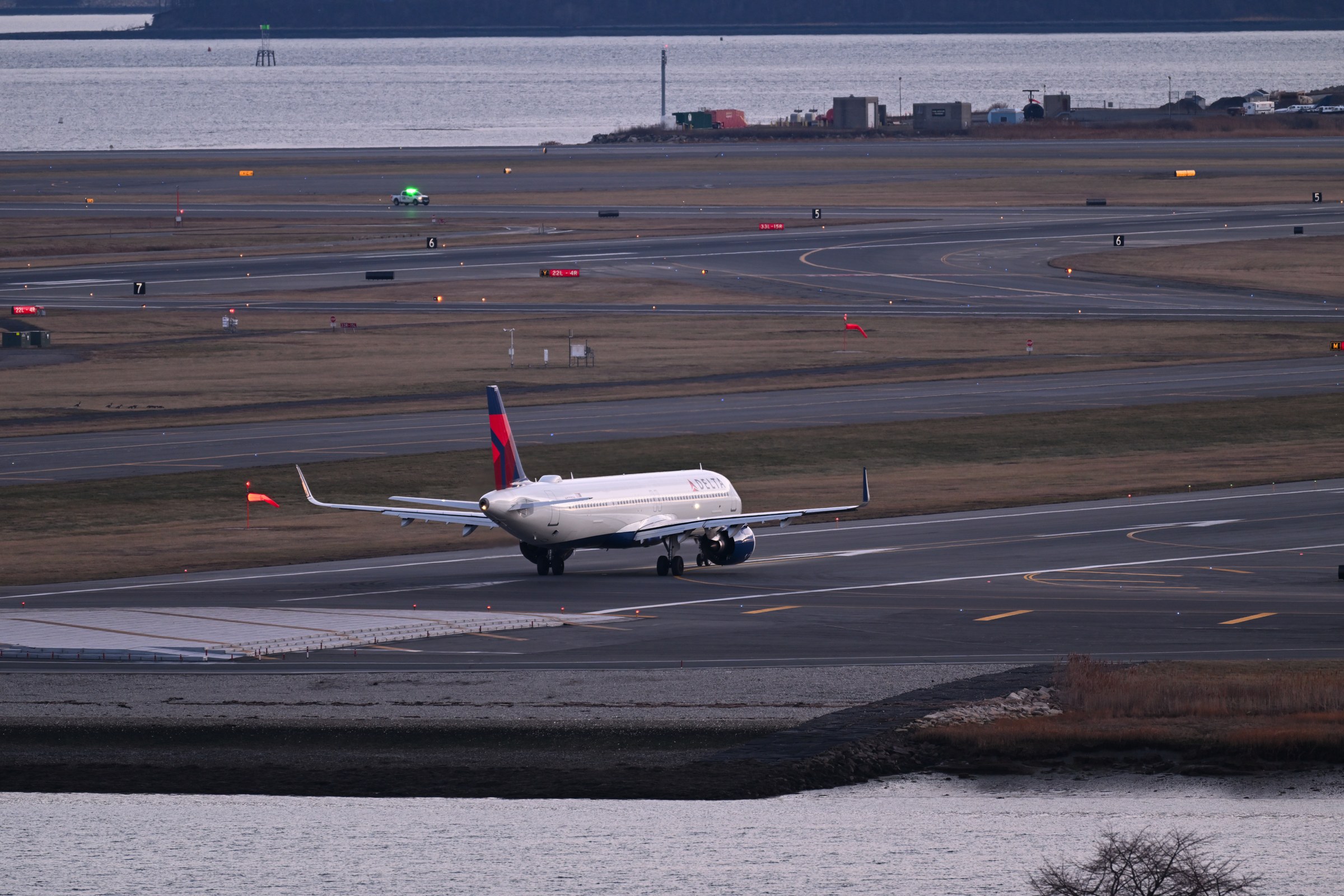
Featured photo: Delta Air Lines Airbus A321neo N577DN lined up for takeoff on Runway 22L at Boston Logan International Airport, Dec. 31, 2024. Photo: 4300streetcar via Wikimedia Commons, CC BY 4.0.
Sources
- FAA, "N JO 7210.979: Line Up and Wait (LUAW) Operations Watch Supervision Requirement" (effective Nov. 24, 2026; digitally signed Oct. 8, 2026, 3:27 PM ET). https://www.faa.gov/documentLibrary/media/Notice/2026-10-09_NOTICE_7210.979_10-3-8_LUAW_Operations_FINALv2.pdf
- AVweb, "FAA Tightens Line Up And Wait Requirements," Matt Ryan, Nov. 24, 2026, 11:48 AM ET. https://avweb.com/aviation-news/faa-tightens-line-up-and-wait-requirements/
- One Mile at a Time, "New FAA Rule For Planes Lining Up On Runways May Cause Delays," Ben Schlappig, Nov. 24, 2026, 12:06 PM ET. https://onemileatatime.com/news/new-faa-rule-planes-lining-up-runways-delays/
- The Washington Post, "Why your Thanksgiving flight may wait longer on the tarmac," Liam Scott, Nov. 24, 2026, 1:21 PM ET. https://www.washingtonpost.com/dc-md-va/2026/11/24/why-your-thanksgiving-flight-may-wait-longer-tarmac/
- FAA, "Trump's Transportation Department Announces Record-Breaking Thanksgiving Air Travel for 2026," Nov. 24, 2026 (time not listed). https://www.faa.gov/newsroom/trumps-transportation-department-announces-record-breaking-thanksgiving-air-travel-2026
How Airline Pilots Fly Red-Eye Flights and Survive Jet Lag