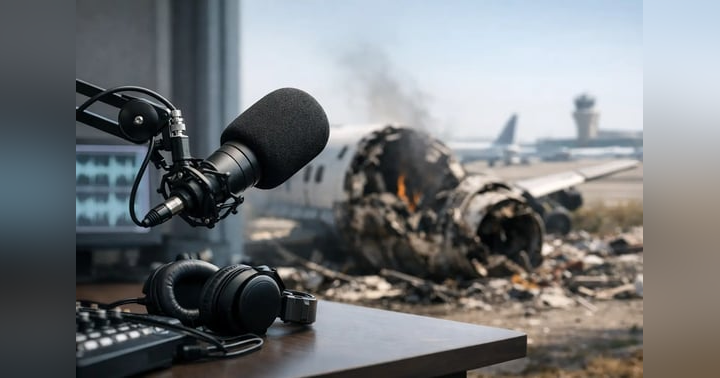
What Makes a Great Aviation Safety Podcast?
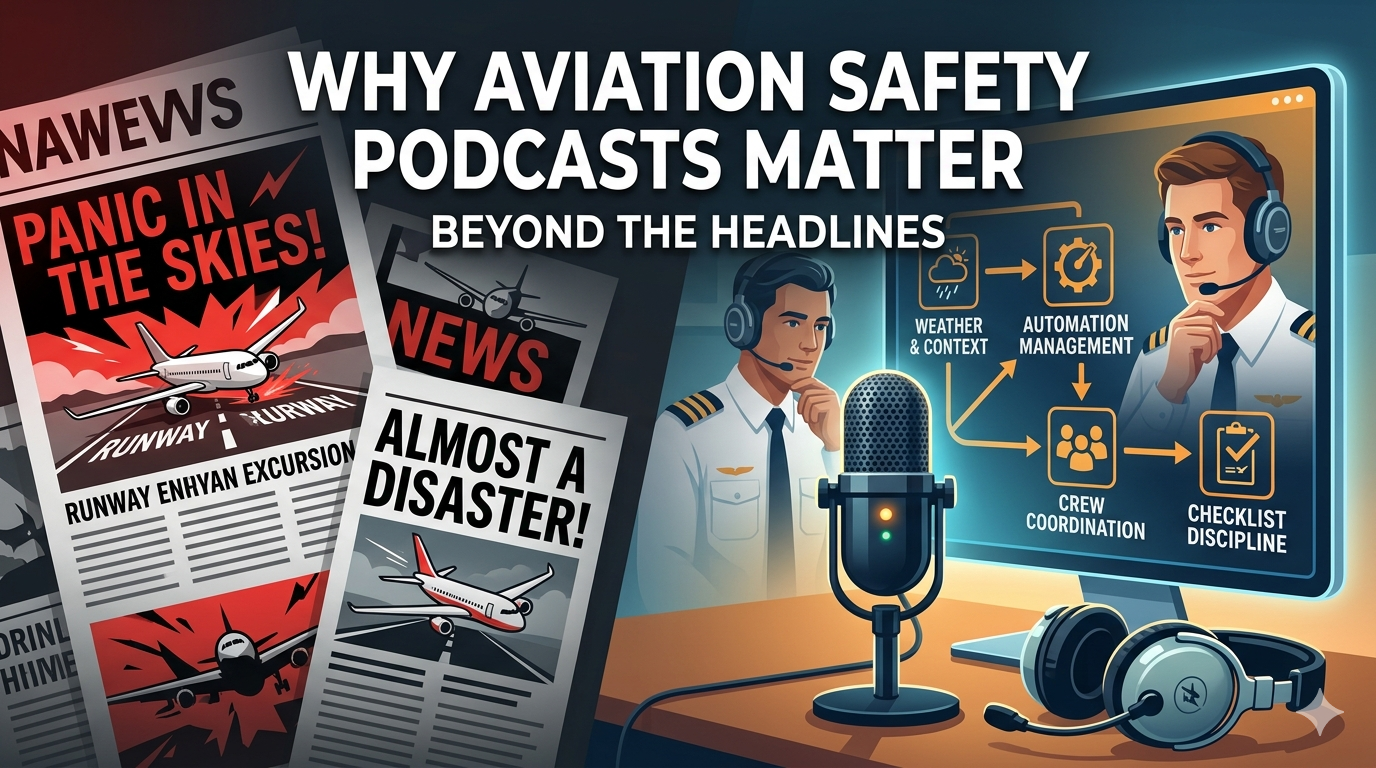
Most people hear about aviation safety only when something goes wrong. A runway excursion makes the news. A near miss triggers a headline. A system failure turns into a social media debate led by people who have never sat in a cockpit, never worked a checklist under pressure, and never had to make a decision with weather, fuel, traffic, and human performance all colliding at once.
That gap is exactly why an aviation safety podcast matters.
Done well, it is not just content for aviation fans. It is one of the few formats that can slow an event down, put it back in operational sequence, and explain what actually happened in language that makes sense to both experienced pilots and serious enthusiasts. Safety in aviation rarely comes down to one dramatic mistake. More often, it is a chain. A good podcast helps people see that chain clearly.
Why an aviation safety podcast works so well
Audio is a natural fit for aviation because so much of flying lives in voice, sequence, and judgment. Pilots brief, call, cross-check, question, and respond. Safety itself is often embedded in communication habits long before it appears in a final report.
A written article can explain facts efficiently. Video can show procedures and visuals. But a strong aviation safety podcast has a different advantage - it can recreate the tempo of a flight crew conversation, the pacing of an abnormal event, and the tension between what should happen and what the crew actually knows in the moment.
That matters because hindsight can distort aviation discussions. Once everyone knows the ending, every wrong turn looks obvious. In reality, crews are working with partial information, imperfect weather pictures, changing aircraft states, and the human limits that affect every profession. A podcast can walk listeners through that uncertainty in a way that feels much closer to the real cockpit environment.
For aspiring pilots, this format builds judgment. For current pilots, it sharpens pattern recognition. For enthusiasts, it replaces sensationalism with context. And for industry watchers, it shows how safety is shaped not only by technology, but by training standards, company culture, regulation, scheduling pressure, maintenance practices, and cockpit discipline.
The difference between real safety analysis and crash entertainment
This distinction matters more than many creators admit.
There is a big audience for dramatic retellings of accidents. Some of that work is useful. Some of it is little more than disaster theater with aviation branding. The difference usually comes down to intent and method.
A serious aviation safety podcast does not treat incidents as spectacle. It treats them as operating lessons. The goal is not to relive the worst moment for drama. The goal is to understand how multiple defenses failed, which safeguards worked, and what changed afterward.
That means resisting easy villains. Sometimes a crew makes a clear error. Sometimes maintenance does. Sometimes management decisions set up the conditions. Sometimes the machine itself creates a trap. Usually, the truth is mixed. That is exactly where good analysis lives.
This is also why pilot and operator perspective matters. Not because professionals are automatically right, but because they understand the environment in which decisions are made. They know how fatigue can narrow options, how automation can help and confuse in the same event, and how checklist discipline can either break an error chain or become diluted when workload spikes.
When safety coverage ignores that context, listeners are left with simple narratives that feel satisfying and teach very little.
What listeners should expect from an aviation safety podcast
The best shows do more than recap. They build a framework for thinking.
First, they establish the timeline carefully. Not a loose retelling, but a sequence. What was the aircraft doing? What did the crew know at each stage? What warnings were available? What environmental factors mattered? In aviation, sequence is everything. Swap the order of two events and the meaning of the entire incident can change.
Second, they separate facts from interpretation. That sounds basic, but it is where a lot of commentary falls apart. Early reports are often incomplete. Witness statements can be useful, but they are not the same as data. Air traffic audio may sound dramatic while still leaving major gaps. A credible podcast tells you what is known, what is likely, and what remains open.
Third, they explain the operational layer. If a crew rejected a takeoff late, why is that decision hard? If an approach became unstable, what cues should have triggered a go-around? If a military intercept occurred, what procedures govern communication, spacing, and escalation? This is where experienced hosts separate themselves from general commentators.
Fourth, they connect the event to broader safety culture. A single accident can reveal training gaps, weak standardization, poor threat and error management, or overreliance on automation. It can also show the opposite - a system under stress that still prevented a worse outcome because one barrier held.
That last part matters. Safety is not only about failures. It is also about recoveries.
The value of hearing from people who have actually flown the problem
Aviation audiences are unusually good at spotting borrowed authority. They can tell when someone is repeating terminology without understanding the underlying operation.
That is why firsthand experience changes the quality of a podcast so much. An airline pilot can explain what a high-workload arrival really feels like. A military aviator can add context on intercept geometry, mission pressure, and tactical communication. An instructor can hear a cockpit mistake and immediately recognize the training habit behind it.
That kind of insight does not make a podcast infallible. Experience has its own biases. A crew member from one segment of aviation may overgeneralize from that world. A military lens does not always fit commercial operations, and vice versa. But when hosts are honest about those limits, the result is far more valuable than surface commentary.
It also makes the storytelling better. Real operators know which details matter because they know which details change outcomes. They do not linger on trivia when the real issue is energy management, situational awareness, crew coordination, or decision timing.
Safety topics that deserve more than a headline
Some of the most useful aviation safety discussions start where mainstream coverage usually stops.
A near miss on the ground is not just a scary airport story. It may involve phraseology, surface movement surveillance, airport layout complexity, crew expectation bias, and controller workload. A decompression event is not only about masks dropping. It opens discussion on aircraft systems, descent priorities, passenger communication, and physiological limits. A military aviation incidentmay have geopolitical angles, but it also has human factors, rules of engagement, and platform-specific constraints.
Even less dramatic topics deserve airtime. Fatigue, unstable approaches, training quality, maintenance reporting culture, checklist drift, radio discipline, and automation management are not flashy, but they shape real-world risk every day.
A useful podcast knows when to cover the major crash everyone is talking about and when to spend an hour on the kinds of smaller breakdowns that professionals know are constantly lurking in the background.
Why credibility matters more than production polish
Good audio quality helps. Tight editing helps. Clear structure absolutely helps.
But in this niche, credibility travels farther than polish. Listeners will forgive a rough edge if the analysis is sharp, the sourcing is disciplined, and the people behind the microphones know what they are talking about. They will not forgive fake certainty, recycled talking points, or commentary that chases emotion over accuracy.
That is one reason brands built around practitioner-led conversation stand out. A show like The Black Box Aviation Podcast works when it brings professional flying experience into the discussion without turning every topic into a lecture. The sweet spot is authority with curiosity. Not just saying what happened, but asking what this means for crews, training, and the broader aviation system.
That approach also respects the audience. Aviation enthusiasts do not need every concept flattened. Pilots do not need every term overexplained. At the same time, a great safety show knows how to bring newer listeners along without talking down to them.
What a great aviation safety podcast leaves you with
The best episodes do something subtle. They make you more careful about certainty.
After listening, you should understand more than the event itself. You should better appreciate how fast routine can become abnormal, how small deviations stack up, and how often good outcomes depend on habits built long before the problem appears. You should also come away with a sharper sense that aviation safety is not static. It is negotiated every day through training, discipline, reporting, design, oversight, and crew judgment.
That is why this category matters. Not because every listener is preparing for a checkride or airline interview, but because aviation is one of the few industries where storytelling can directly support safety culture when it is done responsibly.
The right podcast will not just tell you what failed. It will teach you what to watch for the next time the chain starts forming.
Best Plane Crash Investigation Podcast Picks