"Saw Flames Coming Out of One of Your Engines": American 3230's Mayday Back Into Phoenix
An American Airlines Airbus A319 headed from Phoenix to Portland declared a mayday a few minutes after takeoff Thursday evening and came straight back to Phoenix Sky Harbor. The crew of a SkyWest flight departing behind it had told air traffic control they saw flames coming from one of the American jet's engines. Everyone on board got down safely.
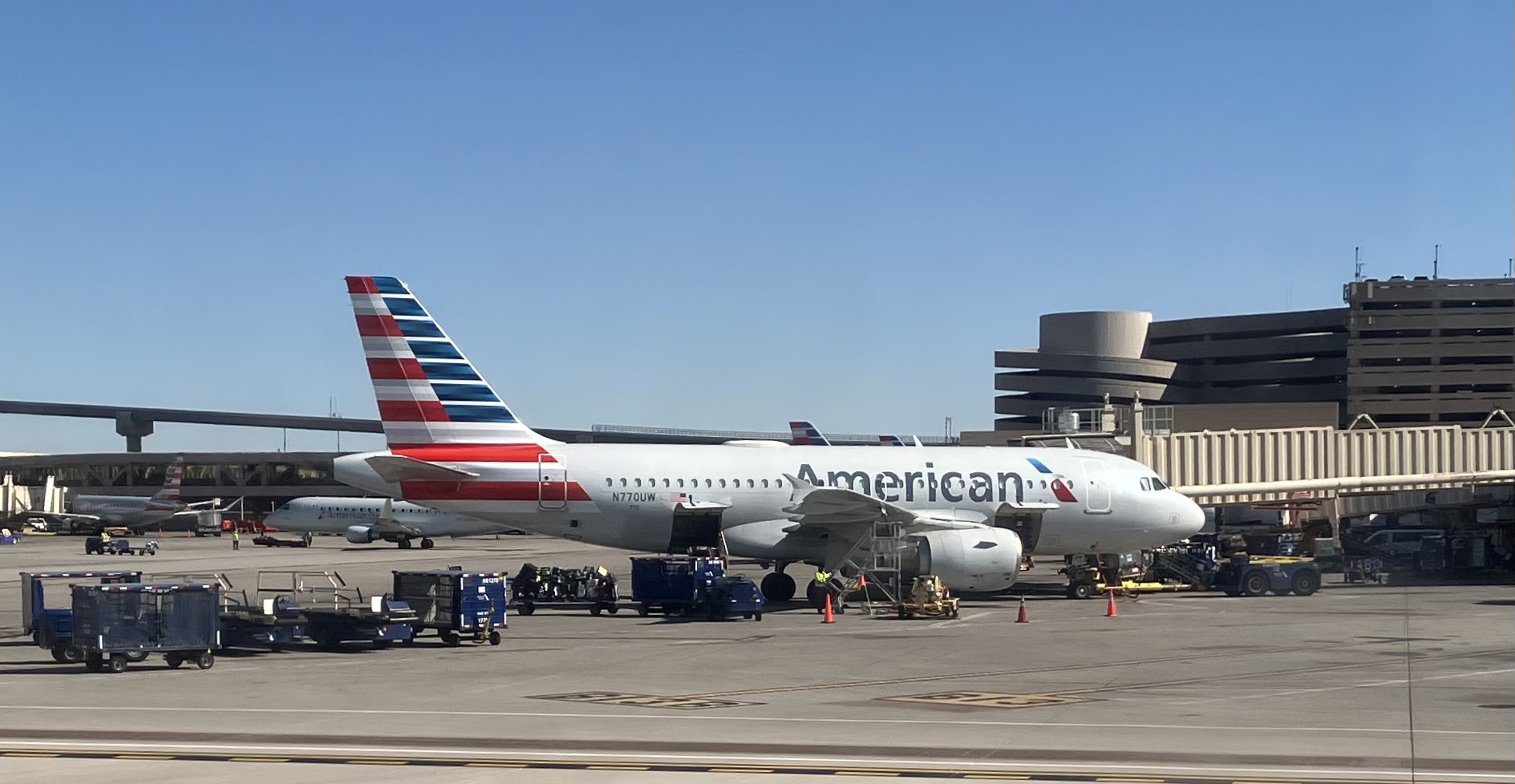
Featured photo: a different American Airlines Airbus A319 (N770UW), not the incident aircraft, at gate A19, Phoenix Sky Harbor, May 2025. Photo: Designism via Wikimedia Commons (CC0 1.0).
What happened
American Airlines flight 3230 left Phoenix around 4:14 p.m. local time (6:14 p.m. ET) on Nov. 19, about 16 minutes late, according to flight data cited by Simple Flying. Shortly after departure, the American crew told the controller they were "working on a hydraulic problem" and planned to come back to the runway.
Then the controller passed along a report from the airplane behind them: "The SkyWest departing behind you said that they saw flames coming out of one of your engines and you might be leaking something," according to ATC audio cited by TheTravel. The controller assigned 7,000 feet, and the crew answered with the call nobody wants to make: "Mayday, Mayday, Mayday, we're going to return to Sky Harbor."
The crew told ATC there were 120 people on board. American told TheTravel there were 113 passengers. The jet was back on the ground at about 4:34 p.m. local, roughly 20 minutes after it left. CNBC-TV18 reported that, in later ATC communications, controllers told the crew the left engine was still smoking and a tire looked flat. American hasn't addressed either of those details publicly.
American said the flight "returned to Phoenix (PHX) due to a mechanical issue," that the aircraft "landed safely, taxied to the gate under its own power and was taken out of service to be inspected by our maintenance team." A spokesperson told the Daily Mail there was no evidence a fire had occurred. Passengers continued to Portland that evening on a replacement aircraft.
Simple Flying identified the jet as N703UW, a 28-year-old A319-112 first delivered to US Airways in 1998 that joined American's fleet after the 2013 merger. As of the overnight reports, American hadn't said what caused the hydraulic problem or what the SkyWest crew saw, and neither the FAA nor the NTSB had commented.
Why this one is worth a closer look
From the flight deck of an A319, you can't see your own engines. You've got gauges, ECAM messages, and whatever the airplane is telling you. So when the crew behind you says "flames" on frequency, that's information you can't get any other way. It's a great example of pilots looking out for each other. The SkyWest crew spoke up, the controller relayed it right away, and the American crew used it.
It also shows how fast things stack up right after takeoff. This crew was already working a hydraulic problem when the flame report came in. The airplane has redundant hydraulic systems, and losing one is something airline pilots train for and run checklists on. A possible engine fire on top of that, at low altitude with the airplane still heavy with fuel for Portland, is a different conversation. Declaring a mayday gets you priority handling and the trucks waiting for you, and it lets the crew focus on flying instead of negotiating with ATC. Coming straight back to the airport you just left, with long runways and emergency crews ready, is about as good an option as you get.
Here's the other side of it: flames seen from outside don't always mean an engine fire, and American says it found no evidence of one. Things like a compressor stall, a tailpipe fire, or burning fluid can all look dramatic from another cockpit. The real answer will come from the maintenance inspection, not from the audio. We'll wait for that before guessing.
Flames from an engine that turn out to be something other than an engine fire is a topic we've covered before. If you want the pilot's view of how those events unfold and what crews do about them, check out our Hot Topic Briefing on Delta Flight 2276's tailpipe fire in Orlando.
For the 120 people on AA3230, it ended the way you want these to end: a quick turn back, a safe landing, a taxi to the gate, and a later flight to Portland. Well done to the crew, the controller, and the SkyWest pilots who spoke up.
Sources
- Simple Flying, "American Airlines Airbus A319 Pilots Declare Mayday After SkyWest Crew Spot Engine Flames" (Aaron Bailey), published Nov. 19, 2026, 10:23 PM ET. https://simpleflying.com/american-airlines-airbus-a319-pilots-declare-emergency-skywest-crew-spot-engine-flames/
- TheTravel, "American Airlines Flight 3230 Catches Fire As Pilot Issues 'Mayday' En Route To Portland," published Nov. 19, 2026, 10:26 PM ET. https://www.thetravel.com/american-airlines-flight-3230-catches-fire-as-pilot-issues-mayday-en-route-to-portland/
- Daily Mail, "American Airlines flight forced into emergency landing after engine catches fire right after takeoff," published Nov. 19, 2026, 11:52 PM ET (updated Nov. 20, 12:27 AM ET). https://www.dailymail.com/news/article-16307909/American-Airlines-emergency-landing-engine-fire-Phoenix.html
- CNBC-TV18, "American Airlines flight declares Mayday after pilot spots flames coming from engine," published Nov. 20, 2026, 12:13 AM ET. https://www.cnbctv18.com/business/aviation/american-airlines-flight-declares-mayday-after-pilot-spots-flames-coming-from-engine-20038374.htm
American Airlines Teams Up With Israir, the Airline Flying Its Old A330s to New York